
Planning to attend the 2026 FIFA World Cup in USA? This guide covers what you actually need before your flight: where the matches are, what to expect in each host country, and how to keep your phone working reliably when you’re moving across international borders.
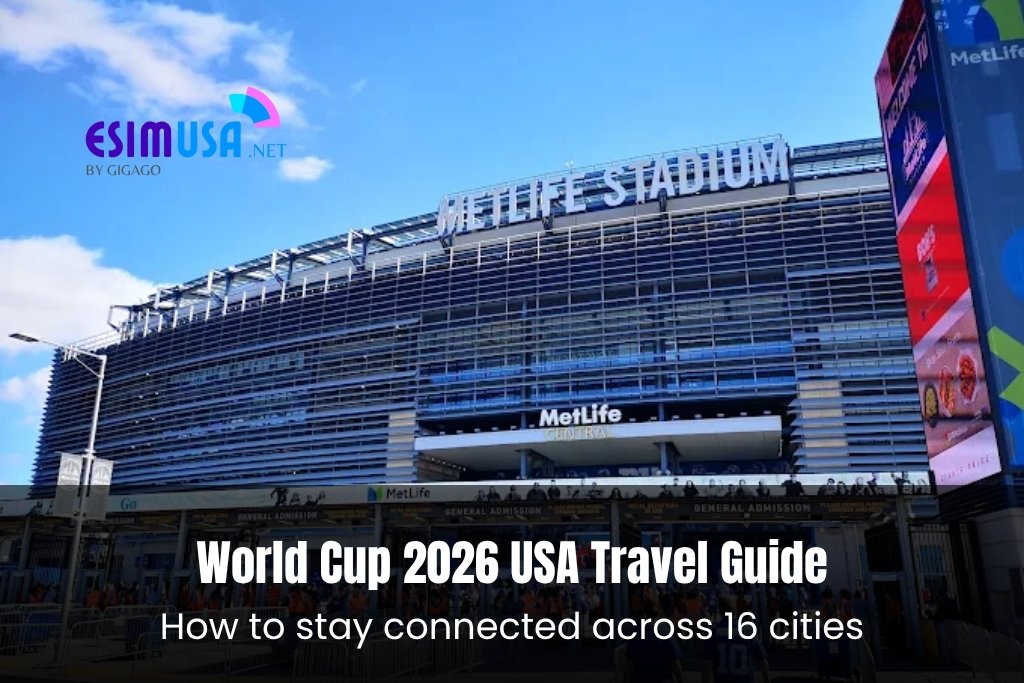
Table of Contents
I. Quick facts about World Cup 2026
The tournament runs June 11 through July 19 across 16 host cities in the United States, Canada, and Mexico. This is the first time in history that a World Cup has been co-hosted by three nations.
- Kicks off: June 11, 2026 at Estadio Azteca in Mexico City
- Wraps up: July 19, 2026 at MetLife Stadium in New Jersey
- Teams: 48 participants (the biggest ever, up from 32 in Qatar)
- Matches: 104 matches spreading across 39 days
- Host nations: USA – Canada – Mexico
- Cities: 16 in total
One number stands above the rest: the USA hosts 60 of 104 matches, including every game from the Quarterfinals onwards. No matter where your team plays in the group stage, the knockout rounds are coming to America.
II. All 16 host cities and stadiums
| Country | City | Matches |
|---|---|---|
| USA | New Jersey – Los Angeles – Dallas – Atalanta – Houston – Miami – Philadelphia – Seattle – Boston – San Francisco – Kansas | 52 Group stage matches + 23 Knockouts + Semifinal + World Cup Final |
| Canada | Toronto – Vancouver | 10 Group stage matches + 3 Knockouts |
| Mexico | Mexico City – Guadalajara – Monterrey | Opening match + 9 Group stage matches + 3 Knockouts |
Did you know?
FIFA renames every sponsored venue for the tournament. Estadio Azteca becomes "Mexico City Stadium," Estadio BBVA becomes "Monterrey Stadium," and so on. Both names refer to the same place.
III. Network coverage for World Cup 2026
AT&T made more than 2,000 network upgrades across all 11 USA host cities, covering not just stadiums, but airports, team camps, and fan festival locations. Verizon also added more 5G spectrum to boost capacity by an estimated 3-5 times across host stadiums, installing thousands of antennas for fans in all sections.
In Canada, the two national carriers Bell and Telus share network infrastructure, which means solid and consistent coverage across both venues.
Telcel holds roughly 60% market share in Mexico, so it will carry the heaviest load on match days. Movistar also runs 5G in Mexico City, Guadalajara, and Monterrey, which can offer a less congested alternative during peak match times.
IV. Why mobile data matters for World Cup 2026
For most travelers, mobile data is no longer a convenience. It is essential infrastructure. Here’s why:
1. Your match tickets are digital
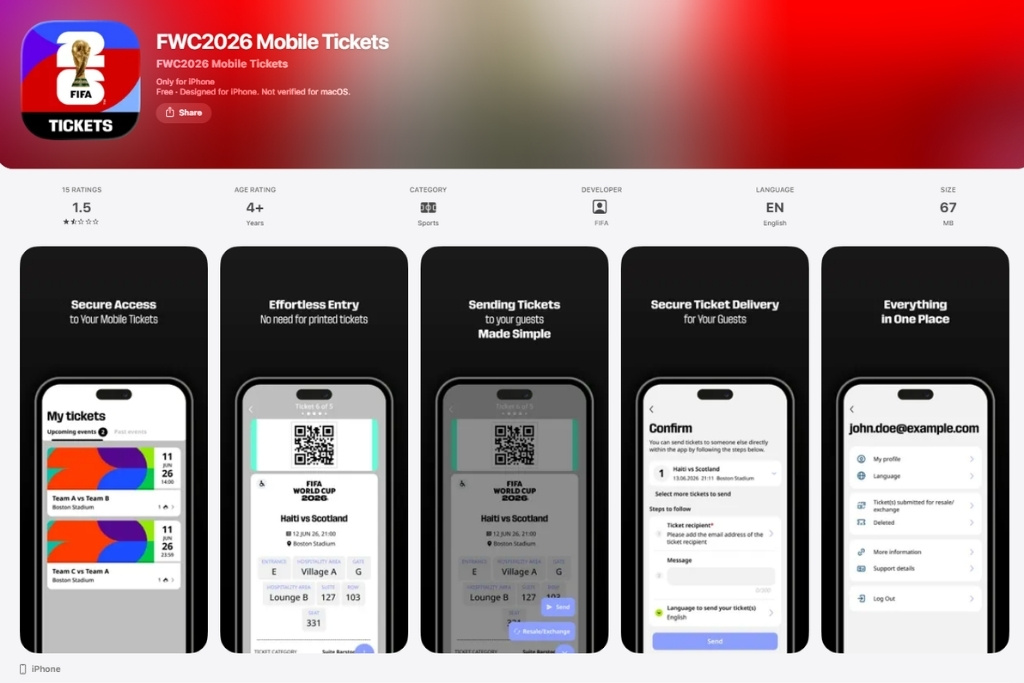
All FIFA World Cup 2026 tickets are delivered exclusively through the FWC2026 Mobile Tickets app. There are no paper tickets, no PDFs, and no email attachments. Screenshots are hardly accepted for stadium entry.
The unique QR code required to enter the stadium becomes visible in the app only on the day of the match, shortly before gates open. This means your phone needs to be charged, the app needs to be installed, and you need an active internet connection on every single match day.
2. Getting to the stadium requires data too
American cities are built for cars. Public transit connections to most World Cup venues are limited, and rideshare like Uber or Lyft is how the majority of fans will travel between games. These apps require a live internet connection to book, track, and pay for rides.
Beyond rideshare, navigating between fan zones, finding the FIFA Fan Festival at each city, and getting from your hotel to the correct stadium entrance all depend on maps running on mobile data in real time.
3. Stadium WiFi will be under serious pressure
Carriers have upgraded their networks significantly. Verizon deployed nearly 140 small cells and temporary cell sites across host cities to boost coverage for fans using mass transit and attending watch events.
But 80,000 fans inside a stadium all uploading a goal celebration at the same moment is a problem. AT&T has engineered its network capacity for 2-3x more traffic than usual, which means the demand will be extreme. Your own eSIM data line gives you a more reliable connection than shared venue WiFi, especially during peak moments.
4. You’ll want to follow other matches
With 104 matches running over 39 days, there will always be more football happening than you can attend. The FIFA World Cup 2026 app offers live data, standings, bracket updates, and real-time notifications, but only if your phone has data. Checking a group table at halftime, watching a highlight from another stadium, staying your fan group chat, all of it runs on mobile data.
V. Best connectivity options for World Cup 2026
Option 1: Roaming with your home carrier
Data roaming is straightforward to set up, but it will be expensive. Most international carriers charge between $10-$15 USD per day for roaming in the US. Rates in Canada and Mexico may differ, and charges often apply per country. A 3-country itinerary can generate three separate daily fees simultaneously. Over a 2-week World Cup trip, roaming costs regularly exceed $200 USD.
Option 2: Buying a Local SIM Card in each country
This method is cheaper per-country, but operationally inconvenient at a tournament. You arrive in Dallas, queue for a SIM. You fly to Toronto, queue again. You cross into Mexico City, queue a third time, at an unfamiliar counter, on a match day. You also lose your original number each time, which matters for WhatsApp groups, hotel confirmations, and two-factor authentication.
Option 3: An eSIM USA
This is the most practical choice. esimusa.net‘s plan installs on your phone before you board the plane. No queues, no SIM cards, no gaps between countries. Your home SIM stays active for calls and your regular number, and the eSIM handles Internet connectivity.
VI. Which eSIM USA plan fits your itinerary
| Your trip | Recommended eSIM USA plan | Price from |
|---|---|---|
| USA matches only | USA eSIM Unlimited Data | $4.00 |
| USA + extended stay (30+ days) | USA eSIM 30 Days | $6.50 |
| USA + Canada matches | USA Canada eSIM | $18.50 |
| USA + Mexico matches | eSIM USA – Mexico | $12.00 |
| Matches across all 3 countries | North America eSIM (USA + Canada + Mexico) | $12.00 |
The standout option for most World Cup travelers is the North America eSIM. If your itinerary touches more than one country, or even if you’re not sure yet, this plan covers all 3 host nations at the same starting price as the two-country plan. One eSIM, one installation, zero border surprises.
VII. Frequently Asked Questions
Can I use my eSIM for hotspot sharing at the stadium?
Yes. Hotspot sharing is supported on all esimusa.net plans. You can connect a tablet or another phone to your data. If you do so, budget an extra 1-2 GB per connected device per hour of active use.
Does the North America eSIM switch networks automatically in Canada or Mexico?
Yes. The eSIM detects the local network such as Bell/Telus in Canada, Telcel or Movistar in Mexico, and connects automatically within a few minutes. No manual configuration, no restart.
Does my eSIM work underground in New York City subway stations?
Partially. T-Mobile leads underground cellular coverage, with service across most Manhattan stations. Some tunnels and outer-borough platforms may remain dead zones. On match day you can download your route and pre-load the FWC2026 Mobile Tickets app before going underground.
Which phone models are compatible with an USA eSIM?
iPhones from XS (2018) onward support eSIM. Most Android flagships from 2019+ do as well. A few exceptions: phones sold in mainland China and some carrier-locked US devices. Please refer to our list of USA eSIM compatible devices.
Can my eSIM be transferred to another device?
In that case, please contact us via Email or Whatsapp. Your eSIM profile can typically be re-issued to a new device using your order confirmation.
How much data do I realistically need for a 10-day World Cup trip in USA?
It will be 3-4 GB for maps, messaging, and general browsing. Add 2.5 GB per HD match you stream, plus roughly 1 GB daily for social media. A 10-day trip will often cost approximately 20-25 GB.
Final Words
Attending the 2026 FIFA World Cup is a once-in-a-generation experience. The matches will be unforgettable. The moments between them: navigating stadiums, finding rides, crossing borders should be seamless, not stressful.
A good connectivity plan doesn’t just save you money on roaming. It saves you time, frustration, and the very real risk of missing a goal because your ticket wouldn’t load. Just install an eSIM before you fly, and enjoy every minute of the World Cup from the opening whistle to the final celebrations.
The tournament kicks off June 11. Whether you're in USA for the Final or in Mexico for the group stage, your USA eSIM handles more logistics than any previous World Cup has required.